How do you achieve success with a business?
Often, the key is to be at the right place at the right time, meeting the needs of people who are willing to pay to have those needs met. But what goes into the planning of that moment in time?
There is a lot to be said for having a business plan, and a marketing plan in place, before you jump in, and try to sell goods, or provide services, or meet some other need that needs to be met. These are steps along the way to having a sense of where you are going, understanding where you've been, and knowing how to interact with others.
Preparation for anything can be a time consuming task. Imagine spending an hour preparing for every minute of a presentation in front of a large audience. That's probably not unreasonable. Now consider spending an hour for every second of a one-on-one presentation. That probably seems like a lot of time. But it might not be unreasonable if you can take what you've learned from the preparation and its presentation, and use if for the next meeting. The metaphor that I've seen many use is, if you were on an elevator, riding with someone who might be interested in your business and you had at the most thirty seconds to describe your business in a persuasive manner, could you?
If you own a business, how much time a week do you spend thinking about the direction of your business, and the goals that you want to achieve? What steps can you take to meet those goals? If you had thirty seconds to describe the mission of your business, could you? What about your vision for the business a year down the road, or two years, or five years? If a customer asked you what your business stood for, would you be able to come out quickly and say something like "Do no evil" like the folks at Google? And then explain how your actions show that you are committed to those values?
I remember the out-of-ring antics of Mohammad Ali, the boxer, as well or better than his in-ring moments. The "float like a butterfly, sting like a bee" soundbites that he gave us which foreshadowed his pugislistic efforts. He was able to float like a butterfly in the ring, as well as sting like a bee. If you make a promise like that, can you live up to it?
Boxing matches are won by hard work and training, and by understanding your opponent. In Mohammad Ali's case, memorable matches where created by not only taking those steps, but also by understanding the audience and knowing how to reach out to them. Those seemingly spontaneous moments when his words danced in front of a crowd during a press conference were part of a plan to entertain and delight, to engage an audience and to make them feel some emotional investment in the outcome.
How do you engage and delight your audience? Do you even know who that audience is? Just as you should be able to come out quickly and describe who you are, what you believe in, and where you are going, you should have a sense of who you are talking to. Who is the right person to give that 30 second speech to, and when is the best time. Realistically, you won't be riding up and down in elevators all day looking for the right person to talk to, or standing in front of an ocean of cameras and reporters in anticipation of a boxing match.
If someone were to call you on the phone, and start asking you questions about your business, can you anticipate the questions that they would ask? Do you know what questions to ask them? What are they going to be interested in finding out? What can you do to prepare for that call, and to even get that phone call?
Who are your customers? That's a good question to ask yourself. And to ask yourself again after you've been in business for a while. You should try to ask, and answer that question on a regular basis. And as you are, you should follow it up with some thoughts about how well you are able to reach out to that audience, and the obstacles that might hinder that type of communication. You should reflect upon the qualities that you and your business possess that help you reach them, too.
One aid in helping you is to make notes for your future self, to give you an idea of how you've learned from your mistakes and your successes. Plan on making a few mistakes, and you may be able to find more success comes to you. Thinking about what you are doing right, and what you are doing wrong is important. Paying attention to the feedback of customers, both positive and negative can help. That record that you maintain of past losses and victories is part of your intellectual capital. It can help you when you find yourself in similar situations in the future.
Part of planning involves understanding your own strengths and weaknesses. Part of it involves knowing the environment where you will be operating, and the obstacles and opponents that you will need to overcome. As Ali recognized, his audience wasn't just limited to the people surrounding the ring on a fight night. Who is your audience? Why should they care about a boxing match when they have so many other things pulling at their attention? Why should your audience care about your business when they have so many other things keeping them busy in their lives?
Who are your competitors, and how are they planning to target that audience? What are their strengths and weaknesses? While you're doing all that floating and stinging, they aren't just sitting there taking it all in. Or are they? Another of Ali's infamous phrases and in-ring tactics was the rope-a-dope in which he let his adversary flail away at him while absorbing the worst of the blows waiting for the right moment to strike. It can hurt being the dope, especially when you are being counted out after being knocked out when you think that you are ahead on points.
Which leads to some other thoughts. Are there different strategies that you should engage in for different aspects of your business? When approaching one market, what is the best way to proceed? What are some alternatives that might make sense. In a boxing ring, you can get a sense of whether the person you are fighting is stronger than you, faster, has a longer reach, or a greater tolerance for pain. If you don't have a plan at that point, you may not have time to make one at all.
Sunday, September 04, 2005


Friday, September 02, 2005
Some search related patent applications
9/8/2005 - looks like these were published a week ahead of time. The links are back online, and working correctly now, and patent applications from last week are also available.
Added on the morning of 9/2/2005 - it appears that the US Patent Office realized that they had the wrong date on the thousands and thousands of patent applications that were published yesterday, or that they had next weeks patents online instead of this week's applications.
The fallout from that discovery is that the links to the patent applications listed below no longer work. The link to the white paper on The Bloomba Personal Content Database still works, though.
I will attempt to repair these links as soon as the Patent Office gets the documents back online.
Published today (though showing a September 8th publication date), the following patent applications looked interesting:
Network traffic monitoring for search popularity analysis
Assessing the popularity of web pages by actually monitoring traffic to those pages with enhanced packet sniffers, and relaying that information to a system that uses a pagerank like system to rank pages.
Keyword recommendation for internet search engines
Using past queries to a search engine to identify and recommend alternative keywords to a person who has entered a query for a search.
Principles and methods for personalizing newsfeeds via an analysis of information novelty and dynamics
A Microsoft approach to personalizing news feeds.
Techniques for parental control of internet access including a guest mode
Yahoo! filters the web, so you don't have to.
Systems and methods for indexing content for fast and scalable retrieval
Raymie Stata's Bloomba Personal Content Database brings Yahoo! a search capability that goes much further than the desktop.
Word collection method and system for use in word-breaking
Microsoft breaks words, so you don't have to.
Sunday, August 28, 2005
Surfing with a Hand Held
I bought a PDA that enables me to surf the web this spring. I like it a lot, but it's shown me that the owners of a lot of sites haven't recognized that people viewing their pages on a small screen is more and more something that will happen.
Cameron Moll looks at some of the ways that sites can prepare themselves for people like me, who want a good experience when visiting their sites with a series of articles on Mobile Web Design.
So far, it has covered the state of mobile computing, and some of the approaches to designing a site with mobile users in mind. I look forward to the last two parts on "Tips and Techniques" for design, and "Application in the Real World."
One article that the first in the series points to this page: 10 Reasons to Publish to Mobile. Some excellent points in there. It's well worth considering how mobile publishing can benefit your business. This is especially true if you are a smaller, leaner, faster business, that can benefit from the agility to change and adapt to future business patterns and changes in technology. One of the points made in the article is that there are 3 times as many mobile devices out in the world today as there are PCs.
Sunday, August 21, 2005
The Importance of Being Found
The web has made location less of an issue for a lot of sites that sell directly online.
I know a few local companies that were able to give up expensive leases, and move to much more affordable warehouses because their internet-based business brought them much more business that walk-in customers.
But, there are many sites online where letting people know the location of their business is one of the main objectives of their site, or at least it should be.
I recently conducted a search for local restaurants in my area on Google, and was really saddened by the results of my search. I was looking at the top 100 results for a query which consisted of the name of the town, the name of the state, and the word "restaurant."
I only saw one result that was an actual local restaurant. All of the other results were directories that may or may not have listed restaurants in the area. I know that a number of local restaurants have web sites. So, why were those failing to show up in the search engine? I took a look at the pages of the restaurants I know are online to find the reasons why.
I came up with a number of things that these places could do that would increase the likelihood that they would be found. These suggestions apply to more places than just restaurants. They could include many different types of small businesses and nonprofit organizations,
You may ask, why would someone take these steps with the growth of local searches on search engines like Google, Yahoo! and MSN? Well, one of the places that these local searches get their geographic information tend to be from regional and topical directories and portals that often charge a fee for a site to be included. Sometimes that fee can be very significant. And people often perform their searches in search engines without bothering to use the tab on those search engines that are for local searches.
Here are some things that can help your site get found in geographically related searches:
1. Include address information on each of the pages of your site, and make sure that it is in text upon those page. There were more than a couple of local restaurants that did have their addresses on each page of their site. But, it was in image text. Search engines can't read images of words.
2. Include a contact page on your site, and provide a number of ways for people to contact you, including phone, mailing address, email addresses, and more. Let people know which time zone you are in if there is a chance of people from other time zones visiting your site. Let them know what your normal businesses hours are, too. Give them an idea of how quickly you will likely response to any questions or comments they might have. Give a brief overview of what you offer on those pages.
3. Have a directions page on your site, and use maps and include photos of the building or buildings that you are in. Make sure you tell them a little about the area, and some of the landmarks or other navigational elements that might make it easier for them to find you. If roads are closed due to construction, let potential visitors know, and tell them about detours that might help them get to you. Again, tell your visitors a little about your business on that page, and tell them why they should come visit you in person.
4. Link to those contact and directions pages from each page of your site. Again, use plain text instead of image text or java script for those links.
5. Consider including a page on your site about the business and its history. In addition to telling visitors about the business, let them know where you are on that page, and what else is nearby. Tell them how far away you are from other towns and cities.
6. If you are involved in the local community, write about it. Tell your visitors about memberships in the local chamber of commerce, main street association, little league sponsorship, and so on.
7. If there are some places nearby that might be of interest to your visitors, tell them about those, and where they are located. If there are a lot of antique shops in your immediate vicinity, let people know that. If you have a world class golf course a couple of miles away, you might be able to attract a couple of golfers for a nice meal after 18 holes. If there are some nearby museums, people might make a trip to see them, and may stop by your restaurant on the way there, or on the way home.
Location is more than just your mailing address. Make sure that address is on your pages, but also let people about the community that you are in, and your part within it. Your web site can help you be found, if you will let it.
Saturday, August 06, 2005
Patently Brilliant
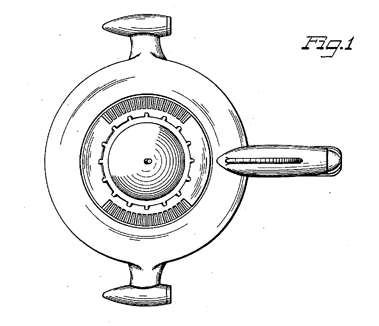
PatentRoom.com examines some great designs from the US Patent and Trademark Office by looking at illustrations from patent applications from the 20s, 30s, 40s, and 50s. Truly great stuff.
One of my favorites is this hood ornament, which I believe I've seen as a spaceship in at least one movie.
Friday, August 05, 2005
USPTO aims at piracy of small business

An excellent new resource from the United States Patent and Trademark Office is the subsection of their site Stopfakes.gov.
They offer some nice descriptions of patents, trade and service marks, and copyright, and about how to protect your intellectual property.
Piracy, counterfeiting and the theft of intellectual property pose a serious threat to all U.S. businesses. Industry estimates of the cost of such theft range from $250 billion to 750,000 jobs per year. Small businesses often find themselves at a particular disadvantage because they often lack the resources and expertise available to larger corporations.
While you can find more detailed materials as the US Copyright Office, and the rest of the USPTO, this site is intended as part of an actual educational campaign with free seminars offered to small business owners to help them learn more about protecting their works.
(via a comment from Alan at Small Business Reading Room)
Tuesday, August 02, 2005
Why is RSS so hard for so many to use? Because we like it that way.
Is it hard for people to use RSS?
Difficult for people to set it up on their sites, or to subscribe to feeds, or to explain?
Cutting Through, in Fixing a 2% problem, acknowledges the possibility that many of us who "get" RSS, and know how to use it might like it that way.
By the way, what percentage of the web understands and uses IRC? Bet it's less than 2%
Spots are hard earned. Don't hide them.
They say they want recruits with "spotless records."
I say "the spots are what matter most."
Spend some time with Tom Peter's Tomato TomA[h]to.
As business manifestos go, it's a pretty good one.
MySpace and the Fox
Do social networks and Big Media mix?
It's a question that the many members of MySpace are asking after its purchase by Rupert Murdoch's News Corp.
It's a question that the many members of MySpace are asking after its purchase by Rupert Murdoch's News Corp.
The web and the people who run it
Definitely worth the read, Kevin Kelly's essay on the growth of the internet: We Are the Web. My favorite passage was this one:
Though they are becoming more rare, there are still companies out there that dismiss the web way too quickly. Good thing. It leaves more room for us folks who run the internet. Millions and millions of us.
This dismissive attitude pervaded a meeting I had with the top leaders of ABC in 1989. I was there to make a presentation to the corner office crowd about this "Internet stuff." To their credit, they realized something was happening. Still, nothing I could tell them would convince them that the Internet was not marginal, not just typing, and, most emphatically, not just teenage boys. Stephen Weiswasser, a senior VP, delivered the ultimate putdown: "The Internet will be the CB radio of the '90s," he told me, a charge he later repeated to the press. Weiswasser summed up ABC's argument for ignoring the new medium: "You aren't going to turn passive consumers into active trollers on the Internet."
I was shown the door. But I offered one tip before I left. "Look," I said. "I happen to know that the address abc.com has not been registered. Go down to your basement, find your most technical computer guy, and have him register abc.com immediately. Don't even think about it. It will be a good thing to do." They thanked me vacantly. I checked a week later. The domain was still unregistered.
Though they are becoming more rare, there are still companies out there that dismiss the web way too quickly. Good thing. It leaves more room for us folks who run the internet. Millions and millions of us.
Monday, August 01, 2005
Microsoft Patents the World

I would have loved listening in on the discussions surrounding the creations of some recent Microsoft patents. I wonder if the inventors were laughing as they wrote these.
At the pace that the Redmond Washington Software company is moving, they might be able to patent everything in the world, within a few years. The New York Times covers the story in: Why Bill Gates Wants 3,000 New Patents.
My favorite is the patent for Custom Emoticons. Just lovely.
Why do we have patents, again?
Google to Lose its Tabs?
That's sort of what is hinted at in a new patent application from the Mountain View Monster of Search: Interface for a universal search
Wasn't too long ago that Amazon lost most of its tabs. (Great article on the History of Amazon's Tabs from Luke Wroblewski .)
Wasn't too long ago that Amazon lost most of its tabs. (Great article on the History of Amazon's Tabs from Luke Wroblewski .)
Friday, June 24, 2005
Blogger Adds Pictures.
 There have been other ways to publish photos to blogger, but now the ability is built directly into the Blogger interface. It's a nice addition.
This is good.
Friday, June 03, 2005
Happy Belated 10th Birthday, Alertbox
I've criticised him, and I've praised him. But, I've also learned a great deal from him.
Dr. Jakob Nielsen's Alertbox turned ten-years-old on June 1st.
If you have a web site, and you haven't looked much at usability, definitely spend some time reading through some of the articles at Alertbox.
It's lasted ten years for a good reason. Its author knows a lot about usability, he shares a lot of it, and he's a great marketer of his services. Happy Birthday, Alertbox.
Make Friday Stress Free
I'm enjoying some of the healthy work related tips at Health-Hack.
Today's timely post is on the subject of Avoiding Stress on Friday Afternoons. Great idea. Many more of them over there.
Today's timely post is on the subject of Avoiding Stress on Friday Afternoons. Great idea. Many more of them over there.
Google's Pay Per Click Patent Application?
This patent application doesn't have the name Google written on it, but some of the names of the inventors might be familar to people who joined in on Google's Orkut when it first started out:
Using concepts for ad targeting
I'd write more about it, but Lisa at Web Marketing News did an excellent job of cutting to the heart of the patent without any doubletalk:
A New Google PPC's Patent?
My favorite lines from the application are these, which Lisa also points out:
Nice to see some not-so-understated drama in legal documents which can often be pretty dry. I'm going to have to look through the last post I made here to see if there were any digs at Google in retaliation.
Using concepts for ad targeting
I'd write more about it, but Lisa at Web Marketing News did an excellent job of cutting to the heart of the patent without any doubletalk:
A New Google PPC's Patent?
My favorite lines from the application are these, which Lisa also points out:
Some Web site hosts have chosen to place advertising revenues over the interests of users. One such Web site is "Overture.com", which hosts a so-called "search engine" service returning advertisements masquerading as "search results" in response to user queries.
Nice to see some not-so-understated drama in legal documents which can often be pretty dry. I'm going to have to look through the last post I made here to see if there were any digs at Google in retaliation.
Thursday, June 02, 2005
Is this Patent Application behind Yahoo's Video Search?
Hard to tell at this point, but this may be part of the method used to help rank results in Yahoo!'s video search. Or maybe an enhancement of Yahoo!'s Image Search.
The inventor of the method described in the patent is John Thrall. The head of media search engineering at Yahoo Search is John Thrall.
Click-through re-ranking of images and other data.
Here's a snippet from the patent application:
It's difficult to tell, but if I were Yahoo!, the person I would want as the head of media search engineering would write patent applications like this one.
The inventor of the method described in the patent is John Thrall. The head of media search engineering at Yahoo Search is John Thrall.
Click-through re-ranking of images and other data.
Here's a snippet from the patent application:
The present invention overcomes the deficiencies and limitations of conventional search engines by using feedback obtained by user clicks and the position of the clicked images to determine user preferences for the search results that best satisfy particular queries. While the embodiments described relate to image data, the present invention can also be used for other types of data such as shopping, video, music, and text searches. For example, the present invention can be used with any type of search where a summary of search results provides detailed and representative information on the content that the user will receive when clicking on the result. User click information is tracked to determine which images users click on for particular queries. This information is used to update and improve future query results.
It's difficult to tell, but if I were Yahoo!, the person I would want as the head of media search engineering would write patent applications like this one.
A Cheap Sales Trick; Or Tommorrow's AI Wonder
You go into a store to purchase something. A salesperson comes over and asks you if you need help.
This person seems fairly agreeable. There's something, you're not quite sure what, about them that you like.
Unknown to you, they are imitating your head movements, your gestures, and some of the other body language you display. It's a studied phenomena, often referred to as the Chameleon effect.
Can it help three dimensional and computer generated beings become more successful salesmen? That's what they've been trying to find out at Stanford.
Sunday, May 29, 2005
Learning from the Past: Fillmore Posters as Promotion
I wonder if there are any clubs out there doing the type of posters that Bill Graham did for San Francisco's Fillmore back in the sixties.
I'm in awe of the great galleries of Fillmore Posters from 1966 through 1969 that were given out to people to remind them to come to shows at the theatre.
I'm in awe of the great galleries of Fillmore Posters from 1966 through 1969 that were given out to people to remind them to come to shows at the theatre.
Wednesday, May 25, 2005
Credibility and the Words You Use
I remember losing a debate because of a head shake.
It was an oral argument in law school, and I had just finished giving a presentation when my opponent started speaking. I found myself pleased that I had anticipated a number of the arguments that my opponent was making, and without even thinking about it, was smiling and shaking my head when she made the points she did. Not because I thought she was right, but rather because I believed that I had addressed those issues.
I thought I had made the stronger argument. Surprisingly, the judge of the event told me that I had lost points and credibility when he saw me shaking my head at the statements my opposition was making, as if I was agreeing with her.
Credibilty can be defined as a mixture of expertise and trustworthiness. The words you use, whether in conversation or in writing, can send a message that you aren't aware of. So can your nonverbal language.
I enjoyed this quick list of words that could also influence whether or not people believe you, and trusted what you are saying during a presentation, or negotiation, or confrontation, or even an interview: 52 Words and Phrases That Weaken Your Credibility
If you find yourself in that type of situation, where you have an audience tryng to determine what message you are sending, keep in mind that your expression, your motions, and your words are all the clues they have about what you are presenting. Even when you aren't the one talking. Credibility doesn't just rely upon what you say, and how you say it, but also how people perceive your message, your demeanor, your appearance, and even the way your head shakes.
Subscribe to:
Posts (Atom)