Saturday, August 06, 2005

Patently Brilliant


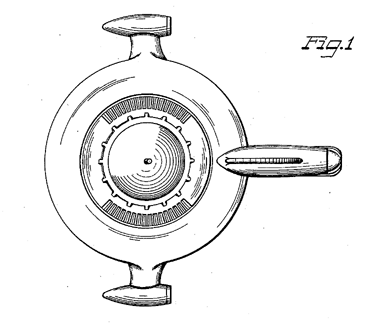
PatentRoom.com examines some great designs from the US Patent and Trademark Office by looking at illustrations from patent applications from the 20s, 30s, 40s, and 50s. Truly great stuff.

One of my favorites is this hood ornament, which I believe I've seen as a spaceship in at least one movie.

Friday, August 05, 2005

USPTO aims at piracy of small business


An excellent new resource from the United States Patent and Trademark Office is the subsection of their site Stopfakes.gov.

They offer some nice descriptions of patents, trade and service marks, and copyright, and about how to protect your intellectual property.

Piracy, counterfeiting and the theft of intellectual property pose a serious threat to all U.S. businesses. Industry estimates of the cost of such theft range from $250 billion to 750,000 jobs per year. Small businesses often find themselves at a particular disadvantage because they often lack the resources and expertise available to larger corporations.


While you can find more detailed materials as the US Copyright Office, and the rest of the USPTO, this site is intended as part of an actual educational campaign with free seminars offered to small business owners to help them learn more about protecting their works.

(via a comment from Alan at Small Business Reading Room)

Tuesday, August 02, 2005

Why is RSS so hard for so many to use? Because we like it that way.

Is it hard for people to use RSS?

Difficult for people to set it up on their sites, or to subscribe to feeds, or to explain?

Cutting Through, in Fixing a 2% problem, acknowledges the possibility that many of us who "get" RSS, and know how to use it might like it that way.

By the way, what percentage of the web understands and uses IRC? Bet it's less than 2%

Spots are hard earned. Don't hide them.

They say they want recruits with "spotless records."
I say "the spots are what matter most."


Spend some time with Tom Peter's Tomato TomA[h]to.

As business manifestos go, it's a pretty good one.

MySpace and the Fox

Do social networks and Big Media mix?

It's a question that the many members of MySpace are asking after its purchase by Rupert Murdoch's News Corp.

The web and the people who run it

Definitely worth the read, Kevin Kelly's essay on the growth of the internet: We Are the Web. My favorite passage was this one:

This dismissive attitude pervaded a meeting I had with the top leaders of ABC in 1989. I was there to make a presentation to the corner office crowd about this "Internet stuff." To their credit, they realized something was happening. Still, nothing I could tell them would convince them that the Internet was not marginal, not just typing, and, most emphatically, not just teenage boys. Stephen Weiswasser, a senior VP, delivered the ultimate putdown: "The Internet will be the CB radio of the '90s," he told me, a charge he later repeated to the press. Weiswasser summed up ABC's argument for ignoring the new medium: "You aren't going to turn passive consumers into active trollers on the Internet."

I was shown the door. But I offered one tip before I left. "Look," I said. "I happen to know that the address abc.com has not been registered. Go down to your basement, find your most technical computer guy, and have him register abc.com immediately. Don't even think about it. It will be a good thing to do." They thanked me vacantly. I checked a week later. The domain was still unregistered.


Though they are becoming more rare, there are still companies out there that dismiss the web way too quickly. Good thing. It leaves more room for us folks who run the internet. Millions and millions of us.

Monday, August 01, 2005

Microsoft Patents the World


I would have loved listening in on the discussions surrounding the creations of some recent Microsoft patents. I wonder if the inventors were laughing as they wrote these.

At the pace that the Redmond Washington Software company is moving, they might be able to patent everything in the world, within a few years. The New York Times covers the story in: Why Bill Gates Wants 3,000 New Patents.

My favorite is the patent for Custom Emoticons. Just lovely.

Why do we have patents, again?

Google to Lose its Tabs?

That's sort of what is hinted at in a new patent application from the Mountain View Monster of Search: Interface for a universal search

Wasn't too long ago that Amazon lost most of its tabs. (Great article on the History of Amazon's Tabs from Luke Wroblewski .)

Friday, June 24, 2005

Blogger Adds Pictures.

ducks walking around, waiting for a meal There have been other ways to publish photos to blogger, but now the ability is built directly into the Blogger interface. It's a nice addition.

This is good.

Friday, June 03, 2005

Happy Belated 10th Birthday, Alertbox

I've criticised him, and I've praised him. But, I've also learned a great deal from him.

Dr. Jakob Nielsen's Alertbox turned ten-years-old on June 1st.

If you have a web site, and you haven't looked much at usability, definitely spend some time reading through some of the articles at Alertbox.

It's lasted ten years for a good reason. Its author knows a lot about usability, he shares a lot of it, and he's a great marketer of his services. Happy Birthday, Alertbox.

Make Friday Stress Free

I'm enjoying some of the healthy work related tips at Health-Hack.

Today's timely post is on the subject of Avoiding Stress on Friday Afternoons. Great idea. Many more of them over there.

Google's Pay Per Click Patent Application?

This patent application doesn't have the name Google written on it, but some of the names of the inventors might be familar to people who joined in on Google's Orkut when it first started out:

Using concepts for ad targeting

I'd write more about it, but Lisa at Web Marketing News did an excellent job of cutting to the heart of the patent without any doubletalk:

A New Google PPC's Patent?

My favorite lines from the application are these, which Lisa also points out:

Some Web site hosts have chosen to place advertising revenues over the interests of users. One such Web site is "Overture.com", which hosts a so-called "search engine" service returning advertisements masquerading as "search results" in response to user queries.


Nice to see some not-so-understated drama in legal documents which can often be pretty dry. I'm going to have to look through the last post I made here to see if there were any digs at Google in retaliation.

Thursday, June 02, 2005

Is this Patent Application behind Yahoo's Video Search?

Hard to tell at this point, but this may be part of the method used to help rank results in Yahoo!'s video search. Or maybe an enhancement of Yahoo!'s Image Search.

The inventor of the method described in the patent is John Thrall. The head of media search engineering at Yahoo Search is John Thrall.

Click-through re-ranking of images and other data.

Here's a snippet from the patent application:

The present invention overcomes the deficiencies and limitations of conventional search engines by using feedback obtained by user clicks and the position of the clicked images to determine user preferences for the search results that best satisfy particular queries. While the embodiments described relate to image data, the present invention can also be used for other types of data such as shopping, video, music, and text searches. For example, the present invention can be used with any type of search where a summary of search results provides detailed and representative information on the content that the user will receive when clicking on the result. User click information is tracked to determine which images users click on for particular queries. This information is used to update and improve future query results.


It's difficult to tell, but if I were Yahoo!, the person I would want as the head of media search engineering would write patent applications like this one.

A Cheap Sales Trick; Or Tommorrow's AI Wonder

You go into a store to purchase something. A salesperson comes over and asks you if you need help.

This person seems fairly agreeable. There's something, you're not quite sure what, about them that you like.

Unknown to you, they are imitating your head movements, your gestures, and some of the other body language you display. It's a studied phenomena, often referred to as the Chameleon effect.

Can it help three dimensional and computer generated beings become more successful salesmen? That's what they've been trying to find out at Stanford.

Sunday, May 29, 2005

Learning from the Past: Fillmore Posters as Promotion

I wonder if there are any clubs out there doing the type of posters that Bill Graham did for San Francisco's Fillmore back in the sixties.

I'm in awe of the great galleries of Fillmore Posters from 1966 through 1969 that were given out to people to remind them to come to shows at the theatre.

Wednesday, May 25, 2005

Credibility and the Words You Use

I remember losing a debate because of a head shake.

It was an oral argument in law school, and I had just finished giving a presentation when my opponent started speaking. I found myself pleased that I had anticipated a number of the arguments that my opponent was making, and without even thinking about it, was smiling and shaking my head when she made the points she did. Not because I thought she was right, but rather because I believed that I had addressed those issues.

I thought I had made the stronger argument. Surprisingly, the judge of the event told me that I had lost points and credibility when he saw me shaking my head at the statements my opposition was making, as if I was agreeing with her.

Credibilty can be defined as a mixture of expertise and trustworthiness. The words you use, whether in conversation or in writing, can send a message that you aren't aware of. So can your nonverbal language.

I enjoyed this quick list of words that could also influence whether or not people believe you, and trusted what you are saying during a presentation, or negotiation, or confrontation, or even an interview: 52 Words and Phrases That Weaken Your Credibility

If you find yourself in that type of situation, where you have an audience tryng to determine what message you are sending, keep in mind that your expression, your motions, and your words are all the clues they have about what you are presenting. Even when you aren't the one talking. Credibility doesn't just rely upon what you say, and how you say it, but also how people perceive your message, your demeanor, your appearance, and even the way your head shakes.

Sunday, May 15, 2005

Serious Batteries Keep Going and Going

Batteries should last for decades.

They may soon. See: New 'BetaBatteries' May Provide Power for Decades

Yahoo Looks At Trends in New Patent Application

After logging into your "my Yahoo" portal, you decide to look for sites about music.

You perform a search for "popular music" in the Yahoo! search engine. If you're under 21, the search engine might return results about Avril Lavgne. If you're over 35, you might see results about Celine Dion instead.

That's one of the potential applications that may come to Yahoo! as a result of the technology described in Systems and methods for search query processing using trend analysis.

A few other recent Yahoo! patent application included the use of concepts gleaned from user queries to help build responses to future queries. This patent application adds an additional element, looking at trends involving

Time - including the times of day that things may be searched for, the changes in searches on weekdays as opposed to weekends, seasonal searches, and more.

Geography - Will people searching for the same terms in different locations expect different results? It's quite possible.

User demographics - Information about users of such services as "My Yahoo" may tell the search engine something about what users of different demographic groups might look for, and what they expect to see.

User history or context (referred to here as a "vertical" dimension) - Information from past searches might influence future results,
etc.

And yes, the Avril Lavgne and Celine Dion examples are part of the patent application.

Wednesday, May 11, 2005

Overcoming the Typing Paradigm

Once upon a time, a friend of mine was telling me what he was looking for in a secretary he had decided to hire for his office. The secretary would be his first employee. One of the requirements he wanted to fill was that this secretary could type as quickly as him. Since he was up to 80 words a minute, that might rule some good candidates out. I told him that he might be making a mistake, and that he might be falling for the Typing Paradigm.


Why I have no love for the typewriter

I remember the good old days, before email was common place in the office, and when you were lucky if you were the one in the office with a computer that had a word processor (fortunately, I was).

I recall having to help replace typewriter ribbons, because they were such a pain to thread into typewriters.

I recollect the temptation to use correction tape on an official document because making a mistake at the end of a typewritten page meant having to type the whole thing over again.

Memories, painful memories of the days of typewriters.

I first learned how to use a wordprocessing program when I had a long paper due in school, and needed to get it done. I installed myself in the school computer lab on a Friday morning, and, except for a few short sleep breaks, spent most of the next few days sitting in front of a terminal, learning how to handle the templates of Word Perfect 5.1. After I had finished 80 pages, and 118 footnotes, my paper was done. And I was just beginning to overcome the typing paradigm.

With a copy of the paper printed out, I also had a copy of the paper on a floppy, so that I could easily add, amend, update, and delete as I saw fit, without having to start over again.

Unknown to me, and even better, my use of Word Perfect's "reveal codes" function was getting me ready for my early days of learning html, where I could separate the content of a page from the look of that page.

The more I learned about how to use different programs, the more I learned that a computer was capable of so much more. And, it made me capable of so much more.

The typewriter took away my potential, and my productivity.


Overcoming the Typewriter Paradigm


After computers became a little more common in my office, and everyone had one that could use Excel, and Word, and Access, I was asked to help format some labels in an old Dbase III program. The labels were going to be attached to a memo asking around 500 contractors if they wanted to use their social security number, or their firm's EIN number on the the 1099 form they would be getting for performing services as a contractor. The form would be printed, photocopied 500 or so times, and the labels would be stuck on to personalize them.

The letters would then be placed in envelopes, with addresses typed on them, and mailed out to those folks. My coworkers were having a hard time getting the old Dbase III program to format the labels correctly. So, they asked for my help. After calculating that their method might take someone a week or so to prepare some ugly looking documents, I asked them if I could take over and do it my way. Unsurprisingly, I received no opposition.

I took the Dbase III database of names, addresses, firm names, social security numbers and EIN numbers, and imported it into Excel (about four minutes). I typed out a template of the original memo in word (about ten minutes). I checked to make sure that we had enough window envelopes (another four minutes). And then I used a mail merge, and printed out 500 or so sharp and stylish looking and professionally drafted, individually personalized letters (a very leisurely hour-and-a-half in which the printer did most of the work).

I noticed a few jaws drop when I came back in about two hours with a stack of documents ready to be folded, put in envelopes, and mailed out.

As you may guess, once a year, it was my job for the next five years to prepare those documents. I tried to teach some of the others during their spare time to use mail merge. They never had any spare time. Somehow, I often did. When I handed in a two week notice, there were some people lined up for crash courses in how to do a mail merge.

A post from Jim Horton, of Online Public Relations, takes a humorous look at Bitter Lessons learned in the ways a mail merge can go wrong. I've been there, Jim. But, I'd rather face those problems that have to type out all of those letters.


Sometimes the World View Changes Easy

I began this post, more than a couple words ago, with a story about a friend who was hiring a secretary. When I started to explain to him that he was making a mistake when he told me he wanted a secretary who was a fast typist, he wanted to know why.

I asked him how many words a minute I was typing when I exported 100 records from Quickbooks into an Excel spreadsheet, merged them with a mail merge into 100 invoices, and printed them out in about twenty minutes. His answer:

"Ok, I want a secretary smart enough not to have to type 80 words a minute."
Tuesday, May 10, 2005

What are the Top Ten Things People Need to Get Out of Your Web Site?

An interesting question in a page from the University of Texas at Austin on Developing Usability Test Documents:

What are the top ten things that visitors need to get from your web site?


That's a good question. I'm going to ramble about what I think those are. I've come up with four general areas where those top ten could come from, after reading that question. I think they are a good start, but I'm going to have to think about this more.

1. Contact Information

I would have to place contact information on that list. I'm not sure I would call it number one, but if the site is an ecommerce site, I like having at least four different types of contact information on a page: email, phone, fax, and mailing address.

Even if people don't use them, just having them there makes people feel confident that there is a real organization behind the pages.

2. A Unique Identity

Chances are that your site isn't the only one that occupies the niche it is in. What makes it different from the others? What do you tell people about yourself, and your business? Why are you different from all of the others?

Seems to me that some of the things that make up a unique identity could fill up a "top ten" list.

3. Promises

There are a lot of promises you make when your run a web site.

You may not even be aware that you are making them, but you are. If someone orders something, you promise to ship them what they've ordered in a reasonable amount of time. If they trust you with personally identifiable information, you may be making a promise in a privacy policy that you will be responsible with that information.

Many of the promises a merchant makes are about things that both the merchant and the purchaser take for granted. For instance, your butcher doesn't have to tell you that the meat he or she is selling to you is fresh. The news reporter promises to follow some set of ethical and editorial guidelines. Those promises are taken for granted, that is, until they are broken.

How would you articulate the promises you make to your customers, and how important are they?

4. The Ability to Make an Informed Decision

Most people are going to be making comparisons between sites, and looking at what they can get offline. If you are going to offer services online, or offer products, give people the information that they need to know that they are making a good choice. Your best customers can often be your present customers.

Let people know they are making an informed decision. Make them feel comfortable and confident, and welcome. And when they come back, welcome them back.

What is the most important information a potential customer should know about what goods or services you have to offer, and how are you telling them about it?


How would you describe the top ten things people need to get from your web site?