Saturday, October 22, 2005

What can a good copywriter do for your online business?

Sometimes you see something on the web that infuriates you.

I did when I saw a blog post from Bob Bly, who has written a number of books about copywriting, titled Why I Don't Believe in SEO Copywriting. In that post, he recommends that if you are going to write copy for a web site page, that you write it first as if it were a stand-alone document, and then you stuff the keywords in the appropriate places, if it really must be ruined by a need to be found by search engines.

I wrote a response there, which I'm going to reproduce here:

I think that your definition of SEO copywriting shows that you don?t really understand SEO. The primary focus is the audience. Search engines are just the way that they arrive on a site, at least if you are good enough at SEO copywriting.

There are a lot of writers on the web who fail to see the framework within which they work. Good writing doesn?t exist in a vacuum. It anticipates not only who the audience is, but how they will get to your site, which path they will follow to the page, whether or not they have other browser windows open, and if they will arrive at a site through the home page, or be delivered, as most people are, to an interior page by a search engine.

When you fail to consider which words an anticipated audience expects to see upon a site, and when you ignore conducting research that can help you use search engines to pull people to a site?s pages, you're sabotaging your own efforts, and potentially harming your clients.


I understand that Bob Bly has a reputation as a fine copywriter, and has written a number of very well received books on the subject. So it surprised me a little to see his words. Then I recalled looking around the shelves of my local Borders at books on copywriting, and picking up his book on "Online Copywriting" and being very disappointed that he didn't seem to have any knowledge of things such as the way people look at web pages, scan text, juggle multiple windows, and often enter sites somewhere in the middle of the site rather than at the front page.

I believe that book has been out a couple of years now, and I suspect that more than a couple of people have read through it hoping to get an idea of how to write for web sites. So, it comes as no surprise to read about the experience the Jeremy Zawodny, from Yahoo! had recently when speaking about search engines to a group from the Direct Marketers Association, in his post, Future On-Line Advertising Growth, based on DMA Conference experience:

In talking to some of the Search Engine Marketing folks that were in sessions on Saturday, I discovered that the vast majority of DMA folks are very, very, very new to Search Marketing. I'd go so far as to say many of them are incredibly clueless about the process, benefits, costs, etc.


I suspect that Rand is spot on in his assessment of how folks outside of SEO might view how search engine marketing works in a post of his today on Mainstream Press and SEO.

Back to Bob Bly's view on the differences between writing copy, and writing SEO copy. He claims that you can only focus upon one audience, and it should be the people reading the pages. If you try to also write for search engines, then your copy loses focus. I can't even begin to agree.

Search engines do not read web pages, they index them. They are not an audience, but rather part of the framework in which you write.

Search engines can help deliver people to those pages that you want your audience to read, and if you can't consider them when you write, then you should stay away from writing for the web. There's a nice recent grokdotcom article that can help you find someone who can write that copy for you: A Persuasive Online Copywriter is Worth More

A look at the man behind Teoma

I remember a few years back hearing about a search engine startup in New Jersey, of all places, created by a professor of mathematics at Rutgers University.

The search engine had the odd name Teoma, and didn't jump out at capture public attention in quite the manner that Google had a few years earlier. But, it was good enough to capture the attention of the folks at Ask Jeeves, who ended up purchasing it, and using it to power their search results.

There's an nice article about the man behind Teoma at David vs. Google. If you are interested in the personalities behind some of the best technology on the web, this is a good place to look.

(via SEO Book)

Sunday, October 16, 2005

IM Merger between Yahoo! and MSN a Great Idea

It doesn't sound like the IM programs that Yahoo! and MSN provide will look any different in the near future. But they will change.

An announcement from both companies tells us that Microsoft and Yahoo will link IM networks.

I use IM everyday at work. It's a useful way to communicate some ideas quickly, and a great way to share URLs with others. It's not the perfect communication tool, but it has its moments.

This "merger" will mean that people on the IM clients from Yahoo! and from MSN will be able to see and interact with each other.

I use the Yahoo! IM program at work, and communicate with some folks on the MSN network at home. The linking of the two networks makes life a little easier.

Measuring Blog Traffic Made Easier

I've signed up to get an invite to tryout a new program from the people at Adaptive Path.

It's a program that helps you discover more about the traffic to your blog. It's described in a blog post by Jeffrey Veen: Welcome to Measure Map.

The screenshot looks like a lot of fun. If I get a chance to try it out, I'll provide more details.

Objectives and Strategies in Web Design

A couple of questions that may not get asked enough when a site is designed, or when it is looked at to make it friendlier to visitors or search engines:

What are the objectives behind your web site?

What strategy will you use to meet those objectives.

Greg Storey, from Airbag Industries, describes a situation that I've seen a few times before, in Never Get Involved in a Land War in Asia (or Build a Website for No Reason).

If you have a web site, can you describe your site's objectives in a sentence or two? Your strategy in a paragraph? If not, you might want to try harder. It can help.

Web Design Mistakes for 2005

There aren't a lot of surprises in Jakob Nielsen's Top Ten Web Design Mistakes of 2005.

I don't agree completely with everything written in the article, but following most of the ideas listed can help a site become more usable to visitors. A set of ten guidelines isn't the answer to every usability problem. But, if you haven't seen these before, they are worth thinking about.

Using Flash

Sometimes, just sometimes, Flash is the best way to show off the subject of a web site. Case in point, the Corpse Bride.

Fun stuff.

Which States are the Best and Worst for Small Business?

The Small Business & Entrepreneurship Council issued their rankings on State's policies toward entrepreneurship.

Ranging from Nice to Nasty - How States Treat Entrepreneurship

The nicest States?

South Dakota
Nevad
Wyoming

The Nastiest?

Maine
California
District of Columbia

The column provides a number of insightful thoughts on why some States rank so poorly.

Tuesday, September 27, 2005

Bling Bling and blogs for Businesses

A nice article at DMNews (Direct marketer news) on how blogs can help ecommerce stores draw more traffic, and make more conversions:

Blogs and Bling Bling: Companies See More Sales, Improve Search Position

I am tempted to suggest that it isn't the blog format as much as it is the communication that blogs offer that make a difference to sites. But, a blog can make it easier to have that conversation with shoppers.

Thursday, September 08, 2005

More search and technology related patent applications

Some technology and search related patent applications from this week and last week:

Lateral search

John Thrall, head of multi-media search engineering at Yahoo, is one of the inventors of this patent application, which melds together general searches with personalized information to enable vertical searches in limited areas, rather than on the whole world wide web.

Method and system for generating recommendations

Another Yahoo! assigned patent application, this one points to the use of collaborative filtering to enable recommendations to be made on products and services from multiple domains, instead of just one site.

Graphical user interface for browsing, searching and presenting media items

This Apple assigned invention describes a graphical user interface for reviewing, browsing, previewing and/or purchasing media items. It describes some digital rights constraints involving encryption and limited usage rights that could be placed upon the music or video purchased and downloaded.

Decision-theoretic web-crawling and predicting web-page change

Microsoft's Chris Meek and Carl Kadie take a detailed look at the way a search engine spiders sites, to send information back to a search engine index. This patent adds the concept of using historical data and predictive assessments of when a page might change in order to decide which pages should be viewed and spidered by the search engine's crawler, and how frequently.

Monday, September 05, 2005

Little bits of information

Light Sockets and Modems - part seven of nine in a series of Questions and Answers with Jeff Bezos, who started the company in his garage a few years ago. All the parts are worth reading.

PocketMod: The Free Disposable Personal Organizer - if you prefer paper to PDA, you might like this application, which helps you build your own customized paper organizer.

Dreaming A New New Orleans, Version 1 - a thoughtful, positive post about rebuilding.

The Customer Is Always Wrong: A User's Guide to DRM in Online Music - I think I'll pass on downloading music from one of the major services for now. Make sure you read all the fine print before you buy.

Sunday, September 04, 2005

Planning for the success of your business.

How do you achieve success with a business?

Often, the key is to be at the right place at the right time, meeting the needs of people who are willing to pay to have those needs met. But what goes into the planning of that moment in time?

There is a lot to be said for having a business plan, and a marketing plan in place, before you jump in, and try to sell goods, or provide services, or meet some other need that needs to be met. These are steps along the way to having a sense of where you are going, understanding where you've been, and knowing how to interact with others.

Preparation for anything can be a time consuming task. Imagine spending an hour preparing for every minute of a presentation in front of a large audience. That's probably not unreasonable. Now consider spending an hour for every second of a one-on-one presentation. That probably seems like a lot of time. But it might not be unreasonable if you can take what you've learned from the preparation and its presentation, and use if for the next meeting. The metaphor that I've seen many use is, if you were on an elevator, riding with someone who might be interested in your business and you had at the most thirty seconds to describe your business in a persuasive manner, could you?

If you own a business, how much time a week do you spend thinking about the direction of your business, and the goals that you want to achieve? What steps can you take to meet those goals? If you had thirty seconds to describe the mission of your business, could you? What about your vision for the business a year down the road, or two years, or five years? If a customer asked you what your business stood for, would you be able to come out quickly and say something like "Do no evil" like the folks at Google? And then explain how your actions show that you are committed to those values?

I remember the out-of-ring antics of Mohammad Ali, the boxer, as well or better than his in-ring moments. The "float like a butterfly, sting like a bee" soundbites that he gave us which foreshadowed his pugislistic efforts. He was able to float like a butterfly in the ring, as well as sting like a bee. If you make a promise like that, can you live up to it?

Boxing matches are won by hard work and training, and by understanding your opponent. In Mohammad Ali's case, memorable matches where created by not only taking those steps, but also by understanding the audience and knowing how to reach out to them. Those seemingly spontaneous moments when his words danced in front of a crowd during a press conference were part of a plan to entertain and delight, to engage an audience and to make them feel some emotional investment in the outcome.

How do you engage and delight your audience? Do you even know who that audience is? Just as you should be able to come out quickly and describe who you are, what you believe in, and where you are going, you should have a sense of who you are talking to. Who is the right person to give that 30 second speech to, and when is the best time. Realistically, you won't be riding up and down in elevators all day looking for the right person to talk to, or standing in front of an ocean of cameras and reporters in anticipation of a boxing match.

If someone were to call you on the phone, and start asking you questions about your business, can you anticipate the questions that they would ask? Do you know what questions to ask them? What are they going to be interested in finding out? What can you do to prepare for that call, and to even get that phone call?

Who are your customers? That's a good question to ask yourself. And to ask yourself again after you've been in business for a while. You should try to ask, and answer that question on a regular basis. And as you are, you should follow it up with some thoughts about how well you are able to reach out to that audience, and the obstacles that might hinder that type of communication. You should reflect upon the qualities that you and your business possess that help you reach them, too.

One aid in helping you is to make notes for your future self, to give you an idea of how you've learned from your mistakes and your successes. Plan on making a few mistakes, and you may be able to find more success comes to you. Thinking about what you are doing right, and what you are doing wrong is important. Paying attention to the feedback of customers, both positive and negative can help. That record that you maintain of past losses and victories is part of your intellectual capital. It can help you when you find yourself in similar situations in the future.

Part of planning involves understanding your own strengths and weaknesses. Part of it involves knowing the environment where you will be operating, and the obstacles and opponents that you will need to overcome. As Ali recognized, his audience wasn't just limited to the people surrounding the ring on a fight night. Who is your audience? Why should they care about a boxing match when they have so many other things pulling at their attention? Why should your audience care about your business when they have so many other things keeping them busy in their lives?

Who are your competitors, and how are they planning to target that audience? What are their strengths and weaknesses? While you're doing all that floating and stinging, they aren't just sitting there taking it all in. Or are they? Another of Ali's infamous phrases and in-ring tactics was the rope-a-dope in which he let his adversary flail away at him while absorbing the worst of the blows waiting for the right moment to strike. It can hurt being the dope, especially when you are being counted out after being knocked out when you think that you are ahead on points.

Which leads to some other thoughts. Are there different strategies that you should engage in for different aspects of your business? When approaching one market, what is the best way to proceed? What are some alternatives that might make sense. In a boxing ring, you can get a sense of whether the person you are fighting is stronger than you, faster, has a longer reach, or a greater tolerance for pain. If you don't have a plan at that point, you may not have time to make one at all.

Friday, September 02, 2005

Some search related patent applications

9/8/2005 - looks like these were published a week ahead of time. The links are back online, and working correctly now, and patent applications from last week are also available.

Added on the morning of 9/2/2005 - it appears that the US Patent Office realized that they had the wrong date on the thousands and thousands of patent applications that were published yesterday, or that they had next weeks patents online instead of this week's applications.

The fallout from that discovery is that the links to the patent applications listed below no longer work. The link to the white paper on The Bloomba Personal Content Database still works, though.

I will attempt to repair these links as soon as the Patent Office gets the documents back online.


Published today (though showing a September 8th publication date), the following patent applications looked interesting:

Network traffic monitoring for search popularity analysis

Assessing the popularity of web pages by actually monitoring traffic to those pages with enhanced packet sniffers, and relaying that information to a system that uses a pagerank like system to rank pages.

Keyword recommendation for internet search engines

Using past queries to a search engine to identify and recommend alternative keywords to a person who has entered a query for a search.


Principles and methods for personalizing newsfeeds via an analysis of information novelty and dynamics

A Microsoft approach to personalizing news feeds.


Techniques for parental control of internet access including a guest mode

Yahoo! filters the web, so you don't have to.


Systems and methods for indexing content for fast and scalable retrieval


Raymie Stata's Bloomba Personal Content Database brings Yahoo! a search capability that goes much further than the desktop.

Word collection method and system for use in word-breaking

Microsoft breaks words, so you don't have to.

Sunday, August 28, 2005

Surfing with a Hand Held

I bought a PDA that enables me to surf the web this spring. I like it a lot, but it's shown me that the owners of a lot of sites haven't recognized that people viewing their pages on a small screen is more and more something that will happen.

Cameron Moll looks at some of the ways that sites can prepare themselves for people like me, who want a good experience when visiting their sites with a series of articles on Mobile Web Design.

So far, it has covered the state of mobile computing, and some of the approaches to designing a site with mobile users in mind. I look forward to the last two parts on "Tips and Techniques" for design, and "Application in the Real World."

One article that the first in the series points to this page: 10 Reasons to Publish to Mobile. Some excellent points in there. It's well worth considering how mobile publishing can benefit your business. This is especially true if you are a smaller, leaner, faster business, that can benefit from the agility to change and adapt to future business patterns and changes in technology. One of the points made in the article is that there are 3 times as many mobile devices out in the world today as there are PCs.

Sunday, August 21, 2005

The Importance of Being Found

The web has made location less of an issue for a lot of sites that sell directly online.

I know a few local companies that were able to give up expensive leases, and move to much more affordable warehouses because their internet-based business brought them much more business that walk-in customers.

But, there are many sites online where letting people know the location of their business is one of the main objectives of their site, or at least it should be.

I recently conducted a search for local restaurants in my area on Google, and was really saddened by the results of my search. I was looking at the top 100 results for a query which consisted of the name of the town, the name of the state, and the word "restaurant."

I only saw one result that was an actual local restaurant. All of the other results were directories that may or may not have listed restaurants in the area. I know that a number of local restaurants have web sites. So, why were those failing to show up in the search engine? I took a look at the pages of the restaurants I know are online to find the reasons why.

I came up with a number of things that these places could do that would increase the likelihood that they would be found. These suggestions apply to more places than just restaurants. They could include many different types of small businesses and nonprofit organizations,

You may ask, why would someone take these steps with the growth of local searches on search engines like Google, Yahoo! and MSN? Well, one of the places that these local searches get their geographic information tend to be from regional and topical directories and portals that often charge a fee for a site to be included. Sometimes that fee can be very significant. And people often perform their searches in search engines without bothering to use the tab on those search engines that are for local searches.

Here are some things that can help your site get found in geographically related searches:

1. Include address information on each of the pages of your site, and make sure that it is in text upon those page. There were more than a couple of local restaurants that did have their addresses on each page of their site. But, it was in image text. Search engines can't read images of words.

2. Include a contact page on your site, and provide a number of ways for people to contact you, including phone, mailing address, email addresses, and more. Let people know which time zone you are in if there is a chance of people from other time zones visiting your site. Let them know what your normal businesses hours are, too. Give them an idea of how quickly you will likely response to any questions or comments they might have. Give a brief overview of what you offer on those pages.

3. Have a directions page on your site, and use maps and include photos of the building or buildings that you are in. Make sure you tell them a little about the area, and some of the landmarks or other navigational elements that might make it easier for them to find you. If roads are closed due to construction, let potential visitors know, and tell them about detours that might help them get to you. Again, tell your visitors a little about your business on that page, and tell them why they should come visit you in person.

4. Link to those contact and directions pages from each page of your site. Again, use plain text instead of image text or java script for those links.

5. Consider including a page on your site about the business and its history. In addition to telling visitors about the business, let them know where you are on that page, and what else is nearby. Tell them how far away you are from other towns and cities.

6. If you are involved in the local community, write about it. Tell your visitors about memberships in the local chamber of commerce, main street association, little league sponsorship, and so on.

7. If there are some places nearby that might be of interest to your visitors, tell them about those, and where they are located. If there are a lot of antique shops in your immediate vicinity, let people know that. If you have a world class golf course a couple of miles away, you might be able to attract a couple of golfers for a nice meal after 18 holes. If there are some nearby museums, people might make a trip to see them, and may stop by your restaurant on the way there, or on the way home.

Location is more than just your mailing address. Make sure that address is on your pages, but also let people about the community that you are in, and your part within it. Your web site can help you be found, if you will let it.

Saturday, August 06, 2005

Patently Brilliant


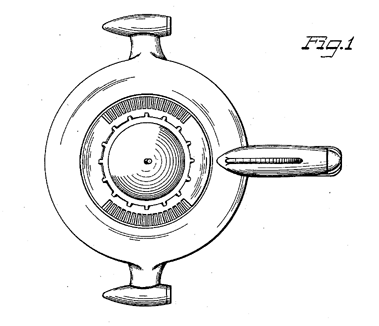
PatentRoom.com examines some great designs from the US Patent and Trademark Office by looking at illustrations from patent applications from the 20s, 30s, 40s, and 50s. Truly great stuff.

One of my favorites is this hood ornament, which I believe I've seen as a spaceship in at least one movie.

Friday, August 05, 2005

USPTO aims at piracy of small business


An excellent new resource from the United States Patent and Trademark Office is the subsection of their site Stopfakes.gov.

They offer some nice descriptions of patents, trade and service marks, and copyright, and about how to protect your intellectual property.

Piracy, counterfeiting and the theft of intellectual property pose a serious threat to all U.S. businesses. Industry estimates of the cost of such theft range from $250 billion to 750,000 jobs per year. Small businesses often find themselves at a particular disadvantage because they often lack the resources and expertise available to larger corporations.


While you can find more detailed materials as the US Copyright Office, and the rest of the USPTO, this site is intended as part of an actual educational campaign with free seminars offered to small business owners to help them learn more about protecting their works.

(via a comment from Alan at Small Business Reading Room)

Tuesday, August 02, 2005

Why is RSS so hard for so many to use? Because we like it that way.

Is it hard for people to use RSS?

Difficult for people to set it up on their sites, or to subscribe to feeds, or to explain?

Cutting Through, in Fixing a 2% problem, acknowledges the possibility that many of us who "get" RSS, and know how to use it might like it that way.

By the way, what percentage of the web understands and uses IRC? Bet it's less than 2%

Spots are hard earned. Don't hide them.

They say they want recruits with "spotless records."
I say "the spots are what matter most."


Spend some time with Tom Peter's Tomato TomA[h]to.

As business manifestos go, it's a pretty good one.

MySpace and the Fox

Do social networks and Big Media mix?

It's a question that the many members of MySpace are asking after its purchase by Rupert Murdoch's News Corp.